Batting
A cricket ball can only do a few things. It is short or full. It is straight or wide. That is nearly the whole menu. Once you can read those two facts fast, batting stops feeling like a hand grenade and starts feeling like a ping pong ball waiting to be hit.
Before the bowler runs in
Stance
Toes lined up with middle stump, feet either side of the crease, about shoulder width. Relaxed but alert. Same every ball, so your eyes get the same view of the world every ball.
Grip
Too round and you close the face, too open and you slice it. You want the biggest part of the bat facing the ball. Top hand steers, bottom hand hits. Hold it firmly, because a bat that moves in your hands at contact costs you power and control at the same time.
Know where off stump is
The most useful piece of geography in batting. If you know it, you know what to leave, and leaving well buys you the time to score later.
Watch the seam, not the ball
Watching the ball is vague. Watching the seam spin is specific, and specific is what your eyes need. Then follow it all the way onto the bat, not to a metre in front of it. If you missed it, this is usually why.
Narrow your eyes to the point of release. Draw a box around the bowling hand and make that box as small as you can, then look at nothing else until the ball is out of it.
on the release boxWatch how Dewald Brevis keeps his eyes on the ball the whole way through, not to a metre in front of the bat but all the way onto it.
Dewald BrevisWhere you stand buys you time
Against somebody genuinely quick, take guard half a metre further back and the ball has further to travel before it gets to you. Against a spinner, do the opposite and stand closer, so it has less room to turn after it lands. Your guard is a setting you are allowed to change, not a mark you are stuck with.
Leaving is a shot
Play it properly. Bat up out of the way, hands high, head still, eyes on the ball the whole way through to the keeper. A leave you have practised tells the bowler you know exactly where your off stump is, and it is the one ball all day that cannot edge to slip.
The ball that gets everybody out
Six to eight metres from the stumps, just outside off stump. Top order Test batters average about 22 against that one ball. Steve Smith averages 23 against it. It is the same ball for the best player in the world as it is for you, so being beaten by a good one is not a fault to go and fix. What you fix is getting out to all the others.
A trigger is a movement, not a stance
Nearly every good batter moves before the ball is bowled. Steve Smith goes back and across, from the middle of his stance to a spot outside off stump, and adopting it in 2013 is what turned his career around. Which way you go matters less than the one rule underneath it: the movement has to be finished before the ball leaves the hand, so that you are still when it does.
Matthew Hayden's first instinct was always length. The moment he saw width he would say the word out loud to himself, and his feet would already be moving.
Notice the order. Length first, then line. Get it that way round and you will feel like you have more time, and you will stop being stuck on the crease with your weight nowhere. Then commit. Timid footwork is death. Go forward or go back like you mean it.
You must always make your first stride to the ball a big one. No half steps. Dean Jones
AB de Villiers describes a small zone near the stumps where the hands, feet and bat all stay. Let the ball come into that space instead of chasing it out of it. Think of a compact golf swing rather than a long lunge.
The box, in his own words
Adjust the size of the box to suit your stance, and make it smaller when the ball is swinging. Then let it bounce into that space. Maximum damage, minimum risk.
AB de Villiers on playing under your eyes and inside your box: a small zone near the stumps where the feet, hands and bat all stay, and the ball is allowed to come to you.
AB de VilliersHow far away it happens
The one measurement you actually control. Against spin in Test cricket, batters who meet the ball between two and two and three quarter metres from the stumps average 28. Meeting it outside that band, either right forward to the pitch of it or right back under your own eyes, averages 50. Nearly twice as many runs off the same ball, decided by where the front foot finished.
See it early, hit it late
Two different jobs. Pick the length the instant it leaves the hand, then be patient about contact. Out of form you get anxious to feel bat on ball and you stretch at it. In form you wait, and it feels slow.
Brendon McCullum.Hit straight, and hit it a lot
A bat is much longer than it is wide. Swing it straight and you present the whole long face. Swing it across and you present the thin edge. That is not opinion, it is the shape of the thing in your hands.
Timing beats fury
Middle it at the right moment and it goes further than any amount of effort. Small backlift, controlled swing, hold the finish. Then, once the timing is real, add the power.
A low backlift, and why you do not need to hit it hard. The bat does the work if it arrives on time.
on the low backliftHigh to low on the cut
On a cut or a pull, the face wants to be looking down at the ground, not up at the sky. Come from high to low and the ball stays down. If you cannot be caught, you cannot be caught.
Sachin Tendulkar on how to cut: get back and across, wait, and come down on it with the face closing over the ball.
Sachin TendulkarOne of the best cuts you will see, and a good thing to slow down and copy frame by frame.
a cut worth studyingExtend the arms on the pull and hook
Short arms means a jammed shot. Get back and across, let the arms go, and aim square rather than straight at the fielder.
Glenn Maxwell talking power hitting with Sam Konstas: extend the arms, aim square, back and across if it is short, and wait until it is inside your box.
Glenn Maxwell and Sam KonstasThe check drive
A full swing that stops at the ball instead of following through. You keep the power and you keep it on the ground, which is the whole point.
The check drive: a full swing that stops at the ball rather than following through, so it stays down and along the ground.
on the check driveRotate the strike, then break the field
Soft hands, quick single, and the fielders come in. Once they are in, there is grass behind them. Hitting into the gaps for one is how you manufacture the gap for four.
A single is an angle, not a hit
Most ones are made by turning the face a few degrees and letting the ball run away behind square. Soft hands, no follow through, and go. Beating a fielder with power needs the gap and the timing at the same time. An angle only needs the gap.
Hit the ground, not the sky
Most catches in junior cricket are balls that never had to be in the air. On anything cross batted, roll the wrists at contact and push it into the turf. On a drive, let the hands finish in front of the ball rather than under it. Decide before you play that the worst thing that can happen is four runs.
The good length band is the one that gets everybody out, and it is the one where playing late in your box does the most work.
Move all you like before the ball is released. At release, stop. Your head should be as still as a rock on a ledge, because every judgement you are about to make is measured from there.
Knees soft, weight over the balls of both feet, hands together on the handle.
The back foot goes back and across, the weight loads onto it, the head does not move.
Front knee at 126 degrees, front elbow at 105, head above the front knee, back heel up.
The knee holds its bend, the bat finishes low, and the ball drops dead at his feet.
Angles are the included angle at the joint, which is what a coach means by a hundred and twenty degrees at the knee. The dotted line is the path of the toe of the bat. The bar under each panel is where the weight is, back foot on the left and front foot on the right.
Score off both feet, or they pick one length
Every bowler you will ever face is looking for the same thing: one length you cannot hurt them from. If there is one, they will find it inside two overs, and then they will bowl it at you until tea. You will not be out. You will just have stopped scoring, and an innings that has stopped scoring usually ends the same way anyway.
What stops that is being able to score off the front foot and off the back foot. Not equally well. Just well enough that neither length is free. Then the bowler has a narrow strip of pitch to hit, and every ball that misses it costs them.
Nothing here is about getting out. It is about how much of the pitch is free. Learn one scoring shot off the back foot and you take four and a half metres of it away from them.
Ricky Ponting made exactly this point on Channel 7 in August 2026, talking about a Test batter in the worst run of his career. There was a technical fault, he said, but the fault mattered less than what it gave away. The player could not score off the back foot, and in Ponting’s words that alone is enough to make batting a hard game. Bowlers had worked out they could land the ball anywhere from about four metres to about ten metres from the stumps, on off stump or wide of it, and not be hurt. Six metres of pitch, free. In the seasons the same player averaged in the sixties, both lengths hurt you, and the band was a sliver.
The one that goes missing is nearly always the back foot. The front foot feels safer, coaches praise it, and driving is the shot everybody practises. So if you can only drive, a bowler who is paying attention pulls the length back by a single metre and you have nothing. One back foot scoring shot that you actually trust is enough to stop that. A cut, or a punch off the back foot through the off side. One, done properly, moves the bowler more than five you half own.
There is a version of this for bowling too, and it is the same sentence turned around. When you are the one running in, you are hunting for that length. Bowl two at a batter's front foot and two at their back foot early on, and watch which one they are comfortable with. Then live at the other one.
Score off both feet, or they choose
A batter who only scores off one foot hands the bowler the length. Six metres of pitch becomes free, and a bowler who is paying attention will live there. Being able to hurt both lengths is worth more than being very good at one.
One back foot shot you trust
Not a repertoire. One. A cut, or a punch through the off side, that you would play in a game without thinking about it. The back foot is the one that goes missing, because driving is what everybody practises and what everybody praises.
Margin for error, theirs not yours
Think about how big a target the bowler is aiming at. Every shot you can play shrinks it, and every one you cannot grows it. That is a better way to judge your own batting than counting how often you get out, because it shows up long before the wickets do.
Move the pitch, not the field
If he has landed six in the same place and the field is set for it, take two steps down before he lets go and the same ball is a half volley. You have not hit it harder and you have not taken a risk. You have changed where it was hit from, and everybody out there is now standing for a shot you are not playing.
Bowl both lengths, then live at one
The same idea from the other end. Early in a spell, give a batter two at the front foot and two at the back foot, and watch which one they look comfortable playing. Then bowl the other one until they show you they have fixed it.
The fault that quietly costs the most
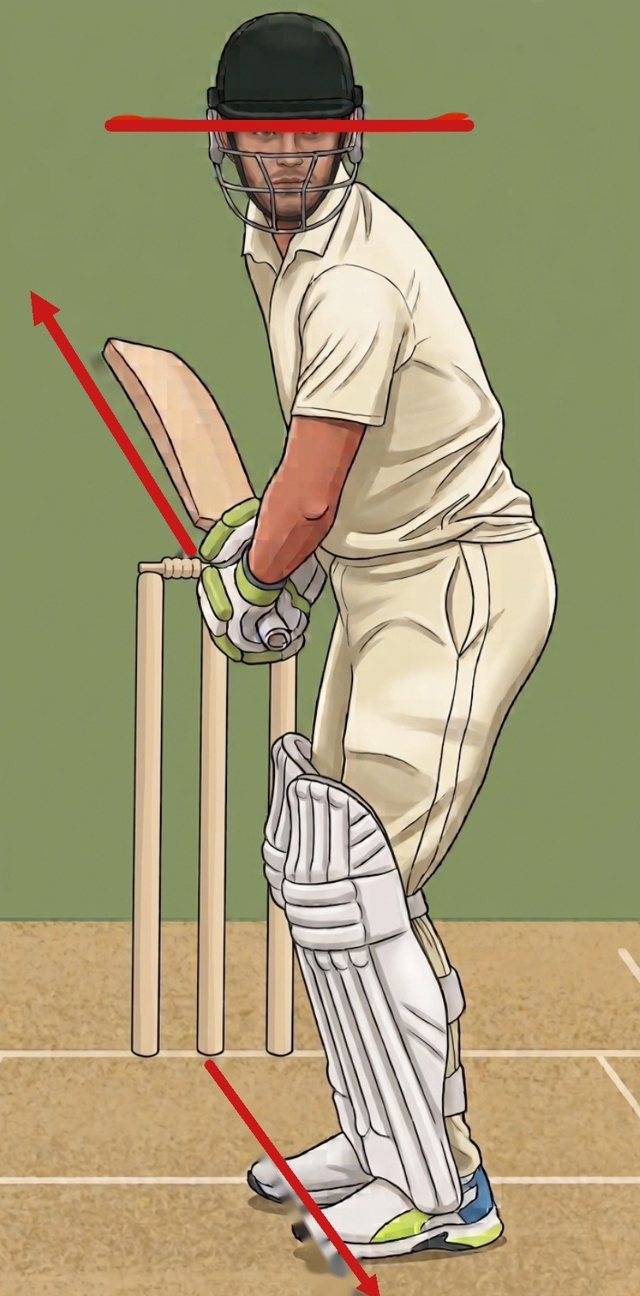
Nearly every young batter who is getting out too often has the same thing going on, and it is not their eyes and it is not their courage. They are standing too open, and because of that the bat comes down inside the line of the ball. It is worth understanding properly, because it is invisible from the inside. Nothing about it feels wrong while you are doing it. It only shows up in the scorebook.
Standing open means your chest and your front shoulder have turned to face the bowler instead of pointing down the pitch at them. From there the bat physically cannot travel down the line of the ball. It has to come across it, in from somewhere near gully and out towards mid on, and it arrives with the face turned towards the leg side. That is what playing inside the line means. Your bat is on the wrong side of the ball, and everything else follows from it.
Both drawn from directly above. Right hander, bowler at the top, off side on the right. The circle is the head and the thick bar across it is the shoulders. The arrow is the path the bat travels on. On the left the bat has to cross the ball's line to get there, so an error in time becomes an error in line as well. On the right the bat is going the same way the ball is going, and being slightly early or late costs you nothing at all.
A bat is long and thin. If the bat is travelling the same way the ball is travelling, being a fraction early or a fraction late costs you almost nothing, because the middle of the bat is still sitting on the line. If the bat is travelling across the ball, the same fraction moves the contact point sideways as well as up and down. Sideways is where the edges are.
So an open stance does not make you miss more often. It makes every miss expensive. The good balls get you out, which is fair enough, and now the ordinary ones do too.
Every mistake turns into an edge
Down the line, an error in timing is just an error in timing. Across the line, it is an error in timing and an error in line at the same time, and the second one is the one that carries to slip. You have made your margin much smaller without noticing.
The gate opens between bat and pad
A bat swinging in from the off side arrives at an angle, so its toe is out somewhere near cover while your front pad is where you left it. The triangle between them is the gate, and it is the tidiest way there is to get bowled by a ball you thought you had covered.
You stop being able to leave
Judging off stump needs your body lined up with it. Turn the shoulders open and your sense of where off stump is turns with them, so you play at balls you should have left and leave balls you should have played. The leaves are the tell. If you have stopped leaving anything, check your shoulders before you check your eyes.
The lbw shouts start
Playing across means the pad gets to the ball before the bat does, and the front leg is usually planted somewhere outside the line of your own body. Straight balls that you used to hit now hit you. Umpires notice this long before batters do.
Half the field goes missing
With the bat coming across, everything goes square on the leg side. Mid wicket and square leg fill up, the captain sees it in two overs, and the off side sits there completely empty with nobody in it. You are getting out more often. You are also scoring in a quarter of the ground.
The gate is the gap between bat and front pad, and notice that it is widest at the bottom, which is exactly where a good length ball arrives. It does not open because you were careless. It opens because a bat swinging in from the off side gets there at an angle, so its toe is out near cover while your pad is still where you put it. Bring the bat down beside the pad and there is nothing left to bowl through.
The clinic
You are standing open
Your chest faces the bowler instead of square leg. That is why you score to leg, and why straight balls bowl you.
Where your chest is pointing
Side on
Your chest faces square leg, straight across the pitch. Your front shoulder points down the pitch at the bowler and you look at him past it.
Open
Your chest has turned towards the bowler. Your front shoulder came round with it, so now it points at midwicket.
Which one you are
Stand in your stance. Get somebody to stand at the bowler’s end and tell you what they can see. Your badge means open. Your shoulder and your sleeve means side on.
It is scoring you runs
Your shoulders are turned towards the leg side before the bowler lets go, so half the work is done. Balls on your pads go round to fine leg. Short ones go over midwicket. On a small ground that is a lot of runs, and you have made a lot of them.
Your best shot works. Here is what it costs.
It cannot come down straight from there
The path
Your arms hang off your chest. Your chest points at midwicket, so your arms swing at midwicket. The bat crosses the line of a straight ball instead of coming down it.
The face
You lift the bat and the face turns out towards second slip. Coming down, it swings in from out near cover instead of passing close to your front pad.
A bat coming down beside your pad has one job. Yours has two.
Arrive on time, and have the face square by that same moment. The ball takes half a second to reach you.
Miss the second one and the ball comes off an angled blade. That is the shot that loops to midwicket when you meant to hit it straight.
Neither of them was a good ball
The straight one
Your front foot goes across, so your pad sits in front of the stumps and the bat has to come round the outside of it. For one instant the bat crosses the line. Either side of that instant your pad is the only thing there, and the ball hits it.
Your pad is standing where your bat should be.
The one that leaves you a fraction
Your bat is out near cover. Your pad has not moved. There is a gap between them, and the ball moves off your pad straight into it and hits off stump.
Your outside edge never comes into it, because your bat is never near your outside edge.
One ball went straight on. One moved the width of a stump. Neither was a good ball.
A captain will work this out
He watches for two overs and sees that every run you make goes between midwicket and fine leg. So he puts a man at deep midwicket, another at fine leg, and tells the bowler to aim at the stumps.
Two men are now standing where you score, and he is bowling where you are weakest. You stop scoring. Then you get out.
Change your shoulder, not your hands
Leave the backlift alone
Somebody will tell you to lift the bat straight. Ignore that. Brian Lara lifted his out towards point and Steve Smith’s goes out towards gully, and both of them bring it down beside the front pad with the face square. Your lift is like theirs. Your downswing is where it goes wrong.
Move two things
Point your front shoulder down the pitch at the bowler and put your chin over the top of it. Then take your back foot back a fraction towards leg stump.
That turns you side on. Side on, the bat comes down straight because there is nowhere else for it to go.
Leave your hands. They are hard to change and the shoulder does most of the work for you.
What right looks like
Sachin Tendulkar drove straighter than anybody. The thing he picked out about Virat Kohli was that he presents the straight bat: the full face arrives facing the bowler, early, and the wrists never have to rescue it.
Rahul Dravid closes the gap. Bat and pad go down together, so the ball that moved a fraction has nowhere to go.
Six drills, in this order
The first three change your shoulder. The last three need it changed already.
- Take your stance and have somebody at the bowler’s end say what they can see. Badge means open. Shoulder and sleeve means side on.
- Lay a rope from middle stump straight down the pitch, shadow bat twenty times, and watch where the toe of the bat crosses it. Outside the line to inside it is the fault, and you will have seen it yourself.
- Stand a spare stump upright a bat’s width outside your front pad, on the off side, and play forward defensives past it. Coming round from outside the line hits the stump. Coming down beside the pad misses it.
- Take your bottom hand off the handle and play twenty balls top hand only. The bottom hand is what drags the bat across. It will feel terrible, and the terrible feeling is the fault.
- Put two cones four metres apart straight down the ground and only count a ball hit between them. Leg side scores nothing, however well you middle it.
- Film thirty seconds from the bowler’s end at knee height. You will see it straight away.
Two things that matter more than the drills
Change one thing. For the next month the only thing in your head walking out is your front shoulder.
And the runs will dry up first. You are giving up a leg side game that works for a straight game that does not exist yet, and everybody who fixes this goes through that.
Keep hitting over midwicket. Just be able to play straight when the ball is straight, so that going leg side is a choice you make.
Brian Lara’s and Steve Smith’s backlifts, and the line about Sachin Tendulkar on Virat Kohli, came through search summaries rather than from the original pages, none of which could be opened from where this was written. They are on the sources page as attributed rather than quoted.
Why nobody chooses it
This is the part that matters if you want to fix it rather than just be told off about it. Nobody decides to stand open. It arrives on its own, for reasons that all make sense at the time, and that is exactly why telling a player to stop does not work.
It is the shape fear puts you in
When something quick is coming at you, your body turns to face it and your front side backs away. That is a sensible thing for a body to do and a terrible thing for a batter to do. Most open stances are not a technical choice at all, they are a flinch that got practised until it looked like a stance.
Two eyes feel safer than one
Turning square gets both eyes onto the bowler and it genuinely feels like you can see better. You cannot, really: side on you are still watching with both eyes, just with your head turned. But the feeling is real, and a fix that ignores it will not last past the first quick bowler.
Nets reward it, matches punish it
Throwdowns and machines mostly arrive on the stumps or at the pads, which is precisely where an across the line swing works. So you practise the fault and it keeps paying, then on Saturday somebody bowls a fifth stump line and it stops paying all at once.
Leg side runs come easy at first
For a year or two, working everything to leg is the fastest way to score, because bowlers at that age are straight and fields are thin. The habit gets paid for a long time before the bill arrives. It arrives the season somebody learns to bowl outside off.
Two or three wheels will get you somewhere sometimes, but not for long. And you will wreck the car. from the notes this site was built from
What to change to, and why
Do not try to fix the bat. The bat is doing exactly what the body is telling it to do, and a batter thinking about their bat swing while a ball is coming is a batter thinking about the wrong thing. Fix the setup, and the swing has nowhere else to go.
Four changes, and they are all things you can check standing still in your kitchen.
Point the front shoulder down the pitch
One cue, and if you only take one thing from this page take this one. The front shoulder aims at the bowler. Not the chest, not the hips, the front shoulder. Everything else lines up behind it on its own, which is why it is worth more than four separate instructions.
Toes to middle, feet where they were
Line your toes up with middle stump, feet either side of the crease, about shoulder width. The feet are usually the honest bit: the ones that are level and pointing across are fine, and it is the shoulders above them that have turned. Set the feet first so you have something true to build on.
Start the bat behind you, not beside you
The bat should lift back towards the stumps and the keeper, not out towards gully. If it goes out, it must come back in, and coming back in is the diagonal. Where the bat starts decides where it travels, and you get to choose that part with all the time in the world.
Bat and pad go down together
Front foot towards the ball, bat coming down right beside it, no daylight between them. This is the oldest instruction in batting and it survives because it makes the gate impossible rather than making it smaller.
Front foot to the ball, not across it
The front foot steps down the line of the ball. If it steps across towards the off side, the hips follow it, the shoulders follow the hips, and you have rebuilt the open stance halfway through the shot. Rahul Dravid put the same idea the other way round when he told Kevin Pietersen to go forward without planting the front foot, so you can still change your mind.
Drills that actually move it
Four drills, roughly in the order to do them. All of them are about making the wrong thing hard rather than asking you to remember the right thing, because under a fast bowler you will not remember anything.
Top hand only
Bat one handed with the top hand, off gentle throws, twenty balls. The top hand steers and the bottom hand hits, so take the bottom hand away and the bat can only come down straight. You will feel where it wants to go, and it will feel oddly easy. That feeling is the target.
Lay a line on the ground
Put a spare stump or a chalk line on the ground running from your toes towards the bowler. Set up with the front shoulder over it. Between balls, look down. This is the whole drill and it is worth more than being told to stay side on a hundred times, because it makes the fault visible to you instead of to somebody else.
Throwdowns from wide of the crease
Get the thrower to stand wide on the off side so every ball comes in on an angle across you. An open stance cannot cope with that line at all, so it stops being a matter of opinion within about six balls. Then move them back to straight and see if it held.
Film thirty seconds from in front
A phone on the ground behind the stumps at the bowler's end, thirty seconds of you facing throwdowns. You do not need slow motion or an app. You are looking for one thing: can you see the gate, and does the bat come down from behind the shoulder or from out to the side. This is the fastest feedback in cricket and almost nobody uses it.
What changes, and how long it takes
The first thing you will notice is that it feels worse. That is not a warning, it is the schedule. A side on setup takes away the leg side flick that has been feeding you runs, and gives you back the off side, which you have not used in a year and are therefore bad at. For a couple of weeks you will score less and it will feel like a mistake.
Then, in roughly this order: the ball starts beating the outside edge instead of taking it, which looks worse and is much better. You start leaving again, and the leaves are calm rather than late. Straight balls stop hitting your pad. The ball starts coming off the middle when you are not really trying, because the bat is on the line and the middle is a much bigger target than it used to be. And the off side opens up, which is where most of the gaps in junior cricket live because nobody is hitting it.
One warning about how to judge it. Do not judge this by runs for the first month, because runs will lie to you in both directions. Judge it the way the rest of this site says to judge everything: did the front shoulder point at the bowler, and did the bat come down beside the pad. Answer those two honestly and the runs turn up on their own schedule.
It gets worse before it gets better
Changing a setup costs you a fortnight of feeling clumsy and a couple of cheap dismissals. Everybody who has ever changed anything has paid this. Knowing the bill is coming is what stops you abandoning the change halfway, which is the only way this actually fails.
One cue, not five
You cannot hold four instructions in your head while somebody bowls at you. Take the whole of this page and shrink it to three words you say before the bowler turns: front shoulder, bowler. Everything above is the reason. Those three words are the thing you actually use.
What you are looking at
Same eleven people, same patch of grass. One way of looking makes you defend. The other makes you score. Michael Bevan built a career on only ever seeing the second one.
We talk about intent. If you are not looking to score, the person bowling to you has already got the upper hand. David Warner
Play to score, always
Every ball, work out how to score off it first, and only defend if you genuinely cannot. Adam Gilchrist played the same way at the start of the day and at the end of it: whatever the ball merited.
Ricky Ponting on how he actually thought at the crease: score runs. Not survive, not see off the new ball. Score runs.
Ricky PontingAbout ten mistakes an innings
A false shot is a ball you edge or miss. Top order Test batters play about eleven of them for every time they get out. Nobody bats without being beaten, so the job is not a perfect innings. It is fewer plays and misses, and more runs in between them.
Watching it all the way is not the same as staring
You do the watching early, out of the hand. By the time the bat comes through, the work is already done, which is how a no look six is possible at all.
Brevis hits a no look six, which sounds like the opposite of watching the ball and is not: he has already done all the watching before the bat comes through.
Dewald BrevisBe still when the arm comes over
Your eyes only work properly from a platform that is not moving. Set up early, stop fidgeting before the arm comes over, and let your feet be the first thing that goes anywhere. Then the head goes with the ball: it turns down the pitch so that the ball stays in the same place relative to your face, which is how your eyes end up barely having to move at all.
Your body moves, your head does not
The head is one of the heaviest parts of you, and holding it still while the rest of you gets into position is the hardest thing in batting. It is also the thing that separates the very best. Set, then travel with the ball, then be completely still and directly over it at the moment you hit it.
Robin Uthappa on AB de Villiers: "his head is still, his eyes are still, and he is tracking the ball". He could keep it still while moving everything else into position.Your eyes get there first
They do not slide along with the ball. They jump ahead of it, twice: once to where it is going to pitch, and again to where you are going to hit it. So the ball arrives into a place you are already looking, which is the only reason watching it onto the bat is possible at all. It is also why being in feels slow.
From eye tracking on two international batters, published in 2013.Given out lbw
Leg before is the second commonest way to get out in Test cricket, about seventeen per cent of all dismissals, behind caught and ahead of bowled. It is also the one nobody practises and the one most argued about on a Saturday, usually by people who have never learned the three questions an umpire is actually answering.
Here they are, and they are asked in this order. Miss any one of them and the finger stays down, however dead in front it looked from square leg.
Seen from directly above, bowler on the left, and the two dashed lines are off stump and leg stump carried all the way down the pitch. That corridor is what "in line" means, and it is narrower than it feels when you are standing in it. The order matters as much as the answers: an umpire asks where it pitched first, so a ball that pitched outside leg is not out no matter how dead in front it looked.
The order is the useful part. Where it pitched is asked first, which is why a ball that pitched outside leg stump is not out no matter what happened afterwards. It is also why bowling round the wicket at a right hander and spearing it in at the pads is a worse plan than it looks.
What you can actually do about it is simpler than the law. Almost every lbw a young batter gets is the pad arriving before the bat, and the pad arrives first because the front foot went across the line instead of down it. Get your bat there and the question never gets asked.
Question one: where did it pitch
If it landed outside leg stump you are not out, and nothing that happened next matters. Learn this one first, because it is the one that gets given wrongly most often in junior cricket.
Question two: where did it hit you
In line between the two sets of stumps, and you are still in trouble. Outside the line of off stump, you are safe if you were playing a shot. Stick your pad at a wide one without offering anything and you have given away the protection.
Question three: was it going on
Would it have hit the stumps. A ball that pitched on a length and hit you on the knee roll is usually going over the top, and one that hit you on the boot is usually crashing into middle. Height is what saves you a long way forward.
The pad is not a second bat
Almost every one of these is the pad arriving first, and the pad arrives first when the front foot goes across the line rather than down it. Bat and pad together, bat slightly in front, and the question does not get asked.
It happens with the new ball
Leg before goes up when the ball is new and moving and comes down as it gets old, because movement is what beats the bat in the first place. The first few overs are when your pads are in the most danger, which is exactly when you are least set.
Reading the bowler
When international batters were shown film of a bowler that stopped at the exact moment the ball left the hand, they could already say what was coming. Club players watching the same film could not. The difference was not eyesight and it was not reactions. The best were reading the bowling arm and the hand, and the others were not looking there at all.
The same study found what that early information is actually for, and it is worth being precise about it, because it is easy to take the wrong lesson. It does not tell you where to put the bat. It tells your feet where to go. The flight of the ball is used at the very end, to fine tune the bat once your body is already in the right place. So none of this replaces watching the ball. It is what gets you into position to watch it properly.
Some of it you read off him, and some of it you read off the ten blokes standing behind him.
The answer is in his hand before it leaves it
Watch the arm and the hand through his last stride, not the patch of air the ball is about to come out of. What you pick up there is what moves your feet, and the flight of the ball is for the end, to fine tune where the bat goes. So this is not instead of watching the ball. It is what puts you in the right place to watch it from.
From studies of international batters facing film cut off at release, 2006.The seam points where it is going
A seam standing up and tilted towards the slips is going away from a right hander. Tilted towards fine leg it is coming back in. Fingers laid flat across the seam and it is not going to swing at all, whatever his arm is doing. That is three different balls told apart before it has left his hand.
The run up tells you the pace
A bowler who shortens his run or comes in slower is about to take the pace off. One who puts something extra into the last stride is about to bang it in. Watch the run up for two overs and you will know his slower ball before he bowls it.
The field is a sentence
Fine leg up means a bouncer is on his mind. A man out at deep square leg means they want you to pull. Extra cover pushed in means they want you to drive. Everybody back means they have stopped trying to get you out and the single is there. Read it before every ball, because it changes before every ball.
And it can be a lie
A fielder moved into a catching position is sometimes a plan and sometimes a decoy. Fine leg brought up is partly there so that you are thinking about the bouncer and go forward half a yard less certain. A captain who knows you are reading him will use it. Take the information, and still watch the hand.
The back of the hand is the other one
A leg spinner turns it away from a right hander out of the front of the hand and back into him out of the back of it. The good ones hide it with the same arm speed and the same flight, and even then the wrist is a fraction more closed than usual. If you cannot pick it, that is not a failure. Play it off the pitch, and be patient.
Find the ball he trusts
Every bowler has one ball he goes to under pressure, and most of them do it without knowing they do it. Get through the first couple of overs, work out what his is, and be ready for it. That is the one you are going to score off.
Play it as late as you dare
AB de Villiers was once asked what he would teach himself first if he could have his career over again. Not a drive, not a pull, and not anything that scores runs.
If I could have my career over again, this will be the first shot that I’ll teach myself: the late block. Once you can play this shot, everything else will come naturally to you. Every shot I play, I set up to play a really late defensive stroke. AB de Villiers
Read the last sentence again, because it is the whole method and it is not what it looks like. He does not pick a shot and then play it. He sets up to block the ball late, on every single ball, and the drive or the cut or the pull only happens if the ball turns out to allow it. The shot comes off the block. The block is not what is left over when the shot goes wrong.
Three things make playing late work, and they stack on top of each other.
The ball has finished moving. Whatever it was going to do, in the air or off the pitch, it has finished doing by the time it gets to you. Play it late and you are playing what the ball actually did. Play it early and you are playing what you guessed it was going to do, and then finding out whether you were right.
It is under your eyes. Late means close to your body, which is where your head can get over the top of it. It is also the difference between a small error in line being a play and miss and a small error in line being an edge. Test batters who meet a spinning ball out in the in between zone, two to two and three quarter metres from the stumps, average 28. Right forward to the pitch of it or right back under their own eyes, they average 50.
You have not committed to anything yet. A late block can still become a drive, a cut or a pull. A drive you committed to when the bowler let go can only become an edge.
The last thing is how it feels, and it matters because it feels wrong. It feels far too late, right up until the moment it works. Then it feels slow, and you wonder why anybody was ever in a hurry.
Set up for the late block, every ball
Not as a plan for the good ones and a panic for the rest. Every ball starts as a late defensive shot, played under your eyes, and the scoring shot happens off that setup when the ball allows it.
AB de Villiers. The first shot he says he would teach himself.Late is where the information is
Everything the ball is going to do, it has done by the time it arrives. Reaching out to meet it means deciding early and finding out late, which is the wrong way round.
It feels too late until it works
Every batter learning this is certain they have left it too long, right up until the first one comes off the middle. After that it feels slow. If it feels rushed, you are still going to the ball instead of letting it come.
Going back to how you used to play
In March 2026 Cameron Green made a hundred for Western Australia in a Sheffield Shield match in Sydney, and afterwards he did something worth copying. He wrote down what he had been doing. Not a diary of the innings, a set of technical notes: where he stood, where the bat was, what the plan was. He called it a time capsule, because he knew what was coming next was a T20 World Cup, an IPL and a run of one day games, and that by the time he was next asked to bat for a day he would have forgotten.
What he had written down was almost embarrassingly plain. Stand reasonably front on. Bat on middle stump. Have a simple plan and do not force anything.
He had spent the previous couple of years moving away from all of it. Across on to off stump, more aggressive from the first ball, trying to make something happen. It is a good way to bat if it is your way to bat. Travis Head can attack from ball one and it costs him nothing, because that is who he is. Green worked out it was never really him, and that he had been playing somebody else’s innings.
You could see the difference in the first Test against Bangladesh in Darwin. His coach Andrew McDonald said Green went in clear on two things, owning the stumps and going down the ground. He left the ball outside off stump, which is exactly the area he had been reaching at before. He drove straight. He looked after the tail. He built at the speed a Test innings is supposed to be built at rather than trying to get there in a hurry, and he made 104 in the second innings, his first Test hundred at home.
His own summary of it was six words long: how I used to play, simple.
Just keeping it really simple, and going back to how I used to play. It is what has worked for me my whole career. Cameron Green
Own the stumps
Bat on middle, reasonably front on, and make the bowler come to you rather than drifting across to meet him. Everything Green wrote down starts here, and it is the same idea as knowing where off stump is, said from the other side.
Cameron Green on going back to how he used to bat: front on, bat on middle stump, own the stumps and hit down the ground. Simple, and his own.
Cameron GreenDown the ground first
The straight drive is the shot that tells you your alignment is right, because you cannot play it from an open position. If it is coming out straight, everything else is in the right place. If it is not, nothing else will be either.
Do not bat like somebody else
Travis Head attacks from the first ball and it works because it is genuinely how he plays. Copying it because it looks good is how Green lost two years. Watch the best player in your team, take the bits that fit you, and leave the rest of it alone.
The long game has its own speed
A long innings is built over hours, not forced in ten overs. If you have played nothing but short games for a while, the first thing to put back is patience, because that is the thing that goes first and it goes without you noticing.
Playing spin
Spin is where most young batters get taken apart, usually by charging blindly down the pitch because that is what looks good on television. There is a much better plan, and the best version of it was written down by Rahul Dravid in an email to Kevin Pietersen, who later published it because it changed how he played.
The same ball every time. All that changes is where the batter's front foot finishes. Get right to the pitch of it and there is no gap between the bounce and the bat for the ball to do anything in. Stay right back and the gap is long, which sounds worse and is actually better, because the turn happens out in front of your eyes with time to watch it. The one place you cannot be is in between, where the gap is just long enough for the ball to turn and just short enough that you cannot see it happen. There is a number on it: Test batters who meet a spinning ball two to two and three quarter metres from the stumps average 28, and batters who meet it outside that band average 50.
Wait for the length
Pick the length as late as you possibly can. Do not decide before the ball has told you anything. The best players of spin in the world are simply the ones who stay still the longest.
Rahul Dravid, to Kevin Pietersen.Do not plant the front foot
Go forward without committing your whole body to it. If it turns more than you expected you can still adjust. A planted foot is a decision you cannot take back.
Ricky Ponting on playing spin: do not over commit by going too far forward. Keep the option to change your mind.
Ricky PontingUse the eye line
Above your eye line as it comes, you can get down the track to it. Below your eye line, stay back and play it off the back foot. That single rule sorts out most of the panic.
The mirror image of what Clarrie Grimmett taught about bowling it.The sweep is a fire blanket
Smother a spinner while the fire is still small. Front foot as close to the pitch of the ball as you can get, back knee down for balance, roll the wrists at contact so it stays on the ground. Sweep it in front of square: Joe Root’s sweeps in front of square go for four about half the time, and behind square about a quarter of the time.
Pick the bowler you sweep
Not every spinner and not every ball. In one Test hundred Root swept none of the first twenty eight balls he faced from the frontline spinners, then swept four of the part timer’s first fifteen. Choose the bowler you have decided to attack and leave the good one alone. That is what makes it a weapon instead of a habit.
Big first stride, or none at all
If you are going down the track, go properly and hit it on the full. If you cannot reach the pitch of it, do not try. Go back and play it off the back foot instead.
Lindsay Hassett to Dean Jones: "watch their ball release, watch the rotation of the seam, and try to get down the track and hit the ball on the full. If you can't get to the pitch of the ball, then play them off the back foot. It's easy!"The no pads drill
Bat against spin in the nets with no pads, or just knee pads. Without pads to hide behind you are forced to get the bat in front and forced to watch the ball. Do not do it the day before a game.
Rahul Dravid: "When you have no pads it will force you, sometimes painfully, to get the bat forward of the pads and will force you to watch the ball."Do not let anyone tell you that you cannot play spin. I have seen you and you can. Rahul Dravid, closing his email to Kevin Pietersen