Batting
A cricket ball can only do a few things. It is short or full. It is straight or wide. That is nearly the whole menu. Once you can read those two facts fast, batting stops feeling like a hand grenade and starts feeling like a ping pong ball waiting to be hit.

Chapter 1Setting up
Down the left of each card: the thing itself, what goes wrong, what to do, how to win with it
Before he lets go of it
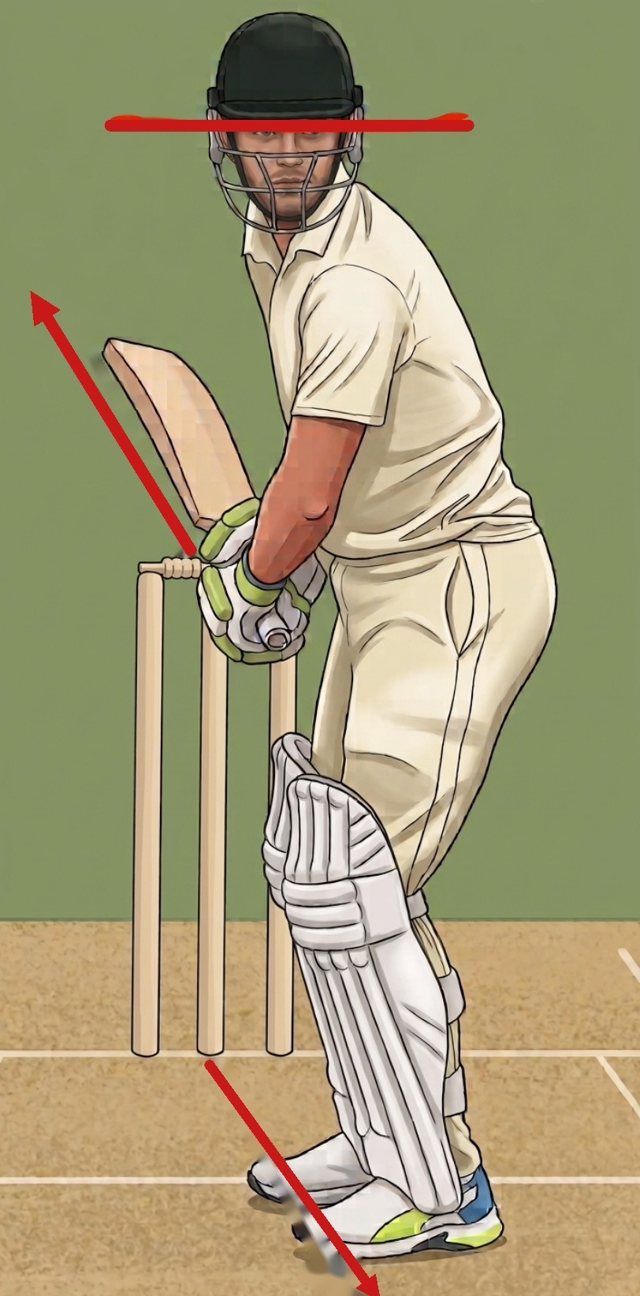 Illustration to come
Stance
As a general rule, take guard on middle stump. Stand side-on, with your back shoulder facing towards second slip rather than square on to the bowler.
Your feet are set. Now your hands.
Grip
Grip the bat the way you would grip an axe.
Lay it flat and pick it up. Check the V of each hand, the gap between thumb and first finger. Both run just left of the middle of the handle if you bat right-handed, just right if you bat left-handed. The bottom hand stays quiet, its V pointing down the bat.
Roll the hands too far around and the face closes, so anything outside off is a leading edge or a miss. Balanced leaves the face free to open for cover and to close for the leg side, and it is still strong enough when you want to hit one. Some players sit stronger because that is where they score. Start balanced, then keep the one that feels like yours.
A lap or a reverse lap can take a small roll of that same grip, for that ball only. Towards the right half of the handle opens the face over short third. The other way opens it over short fine leg.
Stance and grip get you ready to swing. This one is about the swing itself.
Keep the swing close
When you are hitting the ball straight, keep your bat swinging close to your body rather than away from it.
The bat goes back, then comes through on a straight line, not looping out to the side. Take the bat back so it is ready, without throwing your hands away from your body. Elbow and bat stay connected. Coming through on a straight drive, the maker’s name on the face of the bat points down the ground.
Chapter 2The one question
Your front foot goes before you know anything
Stand behind the bowler’s arm at a junior game and watch the batters’ feet instead of the ball. Most of them are already moving forward while the ball is still in the bowler’s hand. Not a trigger movement, which is small and gets you ready. A commitment: weight forward, head forward, finished deciding before there is anything to decide about.
You learnt it from somewhere and it pays you. Going forward gets you to the pitch of the full one, it kills the swing before the swing happens, and every coach you have ever had has told you to get your foot to the ball. Against somebody who only bowls full it works all afternoon.
Here is what it costs. Once your weight has gone forward, the short ball is not a choice you get to make any more. You have to play it from a position you cannot get out of, off a back foot you have already given away. So you fend at it, or you wear it, or you finish the drive you started at a ball that turned out not to be there.
You did not choose to be a front foot player. Your foot chose for you, before the ball was bowled.
So stay still until it is out of his hand, and then ask two questions in this order. Is it full or short? That one, and only that one, decides which foot. Then, where is it going? That decides which shot. Answer them the other way round and you will pick a shot off the line, send the foot with the shot, and find out about the length too late to do anything.
Film thirty seconds from behind the stumps at your end and watch your foot rather than the ball. If it has gone before his arm comes over, the ball is not telling you anything you are using.
Full or short
Read the length first
Every ball, the first question in your head is the same: is it full or short? Get the length right and everything else about the shot gets easier.
Length answered. Now the two ways to move.
Full, go to it
If it is full, go to the ball. Get your front foot in line with it, so your head ends up looking straight down over the top of it.
That is one answer to the question. Here is the other.
Short, go back and across
If it is short, go back and across. Get your head either behind the ball or inside the line of it, depending on which shot you are playing.
Chapter 3Watching it
Your body moves, your head does not
Your body moves, your head does not
The head is one of the heaviest parts of you, and holding it still while the rest of you gets into position is the hardest thing in batting. It is also the thing that separates the very best. Set, then travel with the ball, then be completely still and directly over it at the moment you hit it.
Robin Uthappa on AB de Villiers: "his head is still, his eyes are still, and he is tracking the ball". He could keep it still while moving everything else into position.Play it as late as you dare
AB de Villiers was once asked what he would teach himself first if he could have his career over again. Not a drive, not a pull, and not anything that scores runs.
If I could have my career over again, this will be the first shot that I’ll teach myself: the late block. Once you can play this shot, everything else will come naturally to you. Every shot I play, I set up to play a really late defensive stroke. AB de Villiers
Read the last sentence again, because it is the whole method and it is not what it looks like. He does not pick a shot and then play it. He sets up to block the ball late, on every single ball, and the drive or the cut or the pull only happens if the ball turns out to allow it. The shot comes off the block. The block is not what is left over when the shot goes wrong.
Three things make playing late work, and they stack on top of each other.
The ball has finished moving. Whatever it was going to do, in the air or off the pitch, it has finished doing by the time it gets to you. Play it late and you are playing what the ball actually did. Play it early and you are playing what you guessed it was going to do, and then finding out whether you were right.
It is under your eyes. Late means close to your body, which is where your head can get over the top of it. It is also the difference between a small error in line being a play and miss and a small error in line being an edge. Test batters who meet a spinning ball out in the in between zone, two to two and three quarter metres from the stumps, average 28. Right forward to the pitch of it or right back under their own eyes, they average 50.
You have not committed to anything yet. A late block can still become a drive, a cut or a pull. A drive you committed to when the bowler let go can only become an edge.
The last thing is how it feels, and it matters because it feels wrong. It feels far too late, right up until the moment it works. Then it feels slow, and you wonder why anybody was ever in a hurry.
Set up for the late block every ball
Not as a plan for the good ones and a panic for the rest. Every ball starts as a late defensive shot, played under your eyes, and the scoring shot happens off that setup when the ball allows it.
AB de Villiers. The first shot he says he would teach himself.Late is where the information is
Everything the ball is going to do, it has done by the time it arrives. Reaching out to meet it means deciding early and finding out late, which is the wrong way round.
It feels too late until it works
Every batter learning this is certain they have left it too long, right up until the first one comes off the middle. After that it feels slow. If it feels rushed, you are still going to the ball instead of letting it come.
Chapter 4The swing
Straight first, then everything else
Play straight when you can
As a starting rule, play as straight as you possibly can. You are far more likely to actually hit the ball, and far more in control, simply because of the physics of a straight bat meeting a ball travelling straight at you.
Straight is the default. This is what to do when straight is not on.
High to low on the horizontal shots
When you cannot play it straight, the horizontal bat shots, the pull, the hook, the cut, all follow one rule: swing from high to low. A high backswing lets you come down on the ball. A low backswing only has one way left to go, up, which is how you get caught.
That backswing works because of where it starts. Here is the one that does not.
Where your backswing points
A common mistake: the backswing goes back towards second slip, third slip, or gully instead of straight behind you. From there the bat cannot come through close to your body, it chops across at about 45 degrees instead. That is a harder shot to hit, because now you have to line up the ball coming straight at you and the angle you are swinging across it, both at once.
Fix the swing, and the last decision is simply where to send it.
Hit it where it is
Hit the ball back where it is. Middle stump goes straight back past the bowler. Off side goes to the off side. Leg side goes to the leg side.
The bat comes through too far away from you
Wide feels strong. Long arms, big arc, and when it connects it does go a long way. That part is true, and it is why the habit survives.
What it costs you is time and margin. A bat coming down close to your body travels along the line the ball is on, so it is in the right place for a long moment and a small error in line still finds some middle. A bat coming through from out near cover crosses that line rather than running down it, and it is only in the right place for an instant. Miss the instant and you get the edge, or the leading edge back past the bowler.
It also takes your late options away. Arms already extended cannot adjust, so you cannot let the ball come to you, and anything that arrives close to your body jams you up because the bat has to travel out and then back in to reach it.
The check is one you can do in the back yard without a ball. Shadow bat twenty times and watch where the bat passes your front pad. Inside it, brushing past your hip and your pad, is where it should be going. Out past it, with daylight between the bat and your leg, is the fault, and you will feel how much less time you have.
Chapter 5Playing to score
Think runs, not outs
Think runs, not outs
Think about scoring runs, never about not getting out. A mind that is looking to score puts your feet in better positions and gets you moving towards the ball, without you trying to.
A scoring mind changes your feet before it changes anything else.
Move to the ball
A common mistake is jumping backwards because the ball is a little frightening. Move to it instead. Moving towards the ball is what puts you in control of it, not away from it.
Moving to the ball gets you there. This is what you are moving towards.
Gaps, not fielders
Think about the gaps in the field, not the fielders standing in it. That is where a run actually comes from.
Gaps are the target. Here is the whole shape of an innings around them.
Defend when you must, cash in when you can
Stay in a good position to defend when you need to. Beyond that, look to work the ball into the gaps and rotate the strike with a single. And when the ball is genuinely there to hit, get into position and hit it hard: make the most of a bad delivery, or of a shot you have set up well.